
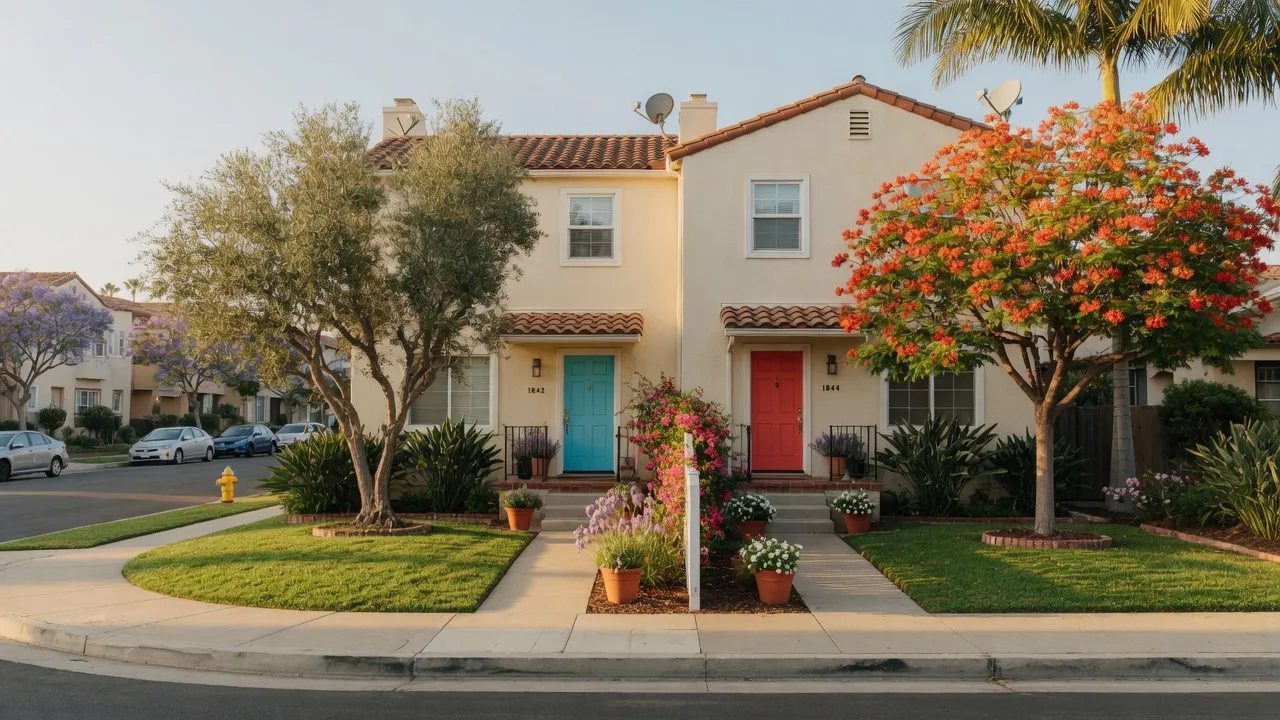
Could a Duplex Help You
Buy a Home Sooner?
Live in one unit. Rent the other.
Explore how an owner-occupied duplex may allow rental income from the second unit to help offset part of your housing expenses.
A Simple Idea
Worth Considering
Buying a home normally means the owner is responsible for the full housing expense. The mortgage, the taxes, the insurance, the maintenance. It is a significant monthly commitment, and for many first-time buyers, that total can feel out of reach.
A duplex creates another possibility. Instead of one home, you purchase a property with two separate living units. You live in one unit and rent the second unit to a tenant.
The rental income from that second unit may help offset part of your housing expenses. Instead of bearing the full cost alone, the duplex allows a tenant to contribute to the mortgage each month.
A duplex is not the right strategy for every buyer, but for those who are open to living in one unit and managing a tenant in the other, it is worth exploring.
How the Duplex
Strategy Works
Buy
Purchase an owner-occupied duplex. Eligible buyers may qualify with as little as 3.5% down through FHA financing or 3% down through conventional programs.
Live
Live in one unit as your primary residence. Owner-occupancy is a core requirement for the low-down-payment financing options that make the strategy accessible.
Rent
Rent the second unit and potentially use the rental income to help offset housing expenses. The tenant's monthly rent may contribute meaningfully to your overall costs.
Owner-occupancy requirements, financing, rental-income treatment, property eligibility and borrower qualification vary by loan program.
Why Some Buyers
Consider a Duplex
Only Two Units
A duplex means just one tenant, which may be more manageable than a triplex or fourplex for a first-time owner-occupant.
More Manageable Scale
With only two units to manage, the learning curve is gentler than with larger multi-unit properties.
Rental Income
The second unit generates rental income that may help offset a portion of the monthly housing payment.
Build Equity
Homeownership builds equity over time through principal paydown and potential appreciation.
Owner-Occupied Financing
Low-down-payment options including FHA (3.5%) and conventional (3%) may be available for owner-occupied duplexes.
Parents Helping Children
Parents may help an adult child purchase a duplex through down payment gifts or co-borrowing arrangements.
Multigenerational
Multiple family members may purchase together, combining resources and sharing the property.
Entry into Income Property
A duplex is a natural first step into small residential income-property ownership with owner-occupied financing.
Present these as possibilities, not guarantees. Every buyer's situation is different, and results depend on the property, market conditions, financing, and individual circumstances.
A Real-World Example:
Simple Numbers
Important: The following is an educational example designed to illustrate how a duplex strategy may work. The 6% interest rate is an example assumption and is not intended to represent current available mortgage rates, loan terms, or an offer of financing.
$71,500 is part of the original educational scenario and does not represent a current qualification requirement. Actual qualification depends on borrower finances, debts, credit, loan program, rate, taxes, insurance, mortgage insurance, underwriting, treatment of rental income and other factors.
What About Your Numbers?
The fixed example above is one possible scenario. Use the calculator below to explore your own assumptions.
MONTHLY BREAKDOWN
Without Rental Contribution
$3,824/mo
With Rental Contribution
$2,324/mo
Estimated Difference
$1,500/mo
This calculator provides estimates for educational purposes only. It does not determine mortgage qualification, loan approval, or financial advice. Actual mortgage payments, taxes, insurance, mortgage insurance, HOA fees, and rental income may vary. Consult with appropriate lending, tax, and insurance professionals.
See How First-Time Buyers Used
This Strategy in Antioch
A young couple purchased their first home using an owner-occupied duplex strategy. Below are the real numbers from that transaction, presented as an educational example.
Arithmetic Verification: $4,872.37 − $2,300.00 = $2,572.37.
Eduardo's Role
- Helped buyers understand the duplex strategy
- Coordinated the buying process
- Helped evaluate the property
- Negotiated the original price
- Negotiated seller credit
- Renegotiated after appraisal
- Helped the buyers ultimately purchase at the $620,000 appraised value
This is a real example from a past transaction. Names and confidential details have been omitted. Past results do not guarantee future outcomes. Every buyer's situation is unique.
Could This Strategy
Fit You?
A duplex may be worth exploring for several types of buyers:
Explore Duplexes
For Sale
Alameda County
Search duplexes in Alameda County on Realtor.com
Contra Costa County
Search duplexes in Contra Costa County on Realtor.com
Solano County
Search duplexes in Solano County on Realtor.com
Looking for duplexes elsewhere in California? Contact Eduardo for personalized assistance.
Want the Complete
Step-by-Step Guide?
Download a comprehensive guide that walks through every stage of the duplex buying process, from financing to closing.
Get the Free Duplex Buyer GuideWhat Client Families Say
First off we want to thank Eduardo for his professionalism and tremendous help during our journey to buy our house. If I could rate him 10 stars I would. Eduardo was very responsive on every call, text and email. Any question we had he would answer us right away and if he didn't know the answer he would find it for us. Eduardo has a lot of experience and made us feel very comfortable working with him. Thank you Eduardo
There aren't words to truly explain how amazing Eduardo is! He was my agent buying my first home which I just purchased. He is so patient and kind and helped me find the perfect place. He went out of his way to make the experience smooth and successful.
Frequently Asked
Questions
Can a first-time buyer buy a duplex?
Yes. First-time buyers can purchase a duplex using FHA financing with as little as 3.5% down, or conventional financing with as little as 3% down, provided they occupy one of the units as their primary residence. The owner-occupancy requirement makes duplexes accessible to qualified first-time buyers who may not have a large down payment saved.
Can I live in one unit and rent the other?
Yes. Owner-occupied duplex financing requires that you live in one of the units as your primary residence. You may rent out the other unit to a tenant. Rental income from the second unit may help offset a portion of your housing expenses, though the treatment of rental income for qualification purposes depends on the loan program and underwriting guidelines.
Can rental income help with qualification?
In some cases, a portion of projected or existing rental income from the second unit may be considered by lenders when qualifying for an owner-occupied duplex. The specific treatment varies by loan program (FHA, conventional, VA), underwriting guidelines, and whether the property has a rental history. A qualified mortgage professional can provide guidance on how rental income may apply to your situation.
How much down payment might be needed?
Down payment requirements depend on the loan program and the purchase price. FHA loans may allow as little as 3.5% down for qualified borrowers. Conventional loans may start at 3% to 5% down. Some state and local programs may offer down payment assistance. Each program has its own eligibility criteria, credit requirements, and limits.
How is buying a duplex different from a single-family home?
Buying a duplex involves additional considerations beyond a single-family home purchase. These include evaluating the condition and income potential of both units, understanding landlord responsibilities, reviewing existing leases if the property is tenanted, and complying with local rental regulations. Financing an owner-occupied duplex follows similar guidelines to single-family homes under most programs, but the appraisal and underwriting may consider the property's income potential.
Can parents help an adult child purchase?
Yes. There are several ways parents may help an adult child purchase a duplex, including gifting funds for the down payment, co-signing or serving as a non-occupant co-borrower on the loan (where permitted by the loan program), or purchasing the property jointly. Each approach has different qualification requirements and should be discussed with a mortgage professional.
Can multiple family members purchase together?
Yes. Multiple family members may purchase a duplex together as co-borrowers, provided they meet the loan program's occupancy and qualification requirements. This can be a way to combine resources and share housing expenses. The specific structure and qualification criteria depend on the loan program and lender guidelines.
What expenses should buyers consider?
Beyond the mortgage payment, duplex owners should budget for property taxes, homeowners insurance, mortgage insurance (if applicable), HOA fees (if applicable), maintenance and repairs for both units, vacancy periods between tenants, property management (if hired), and landlord insurance. Creating a realistic budget that includes these expenses is an important step before purchasing.
Is it an investment property if the buyer occupies one unit?
No. An owner-occupied duplex is classified as a primary residence, not an investment property, for financing purposes. This distinction is important because it allows borrowers to access lower down payment options and more favorable loan terms typically reserved for primary residences. The second unit generates rental income, but the property is primarily the buyer's home.
Where can buyers find duplexes in Alameda, Contra Costa and Solano Counties?
Duplexes in these counties are listed through the local Multiple Listing Service (MLS) and can be found on major real estate search platforms. Eduardo can help set up custom property alerts and guide buyers through the search process. Buyers may also contact Eduardo directly for assistance finding duplexes in specific communities throughout Alameda, Contra Costa, and Solano counties.

Curious Whether a Duplex
Could Work for You?
You can start by understanding the numbers, available properties and financing considerations. Eduardo can help evaluate the real estate strategy and coordinate with an appropriate qualified mortgage professional when financing guidance is needed.
Explore My Duplex OptionsEduardo Ledesma
Real Estate Consultant & Auctioneer
Realty ONE Group Future · DRE# 01198626
510-799-6388Hablo Español
The information on this page is for educational purposes only and does not constitute legal, financial, tax, or real estate advice.
Financing terms, eligibility, and qualification requirements vary by loan program and lender. Mortgage rates change frequently.
Rental income is not guaranteed. Actual rents, vacancy rates, and expenses vary by property, location, and market conditions.
Treatment of rental income for mortgage qualification purposes varies by loan program and underwriter guidelines.
Calculator results are estimates only and do not represent a mortgage approval, commitment, or guarantee of any kind.
Property values, market conditions, and availability of properties change over time. Past transaction examples do not guarantee future results.
Appropriate lending, tax, legal, and insurance professionals should be consulted regarding your specific situation.
Equal Housing Opportunity. Eduardo Ledesma, DRE# 01198626, Realty ONE Group Future.
Explore More Resources